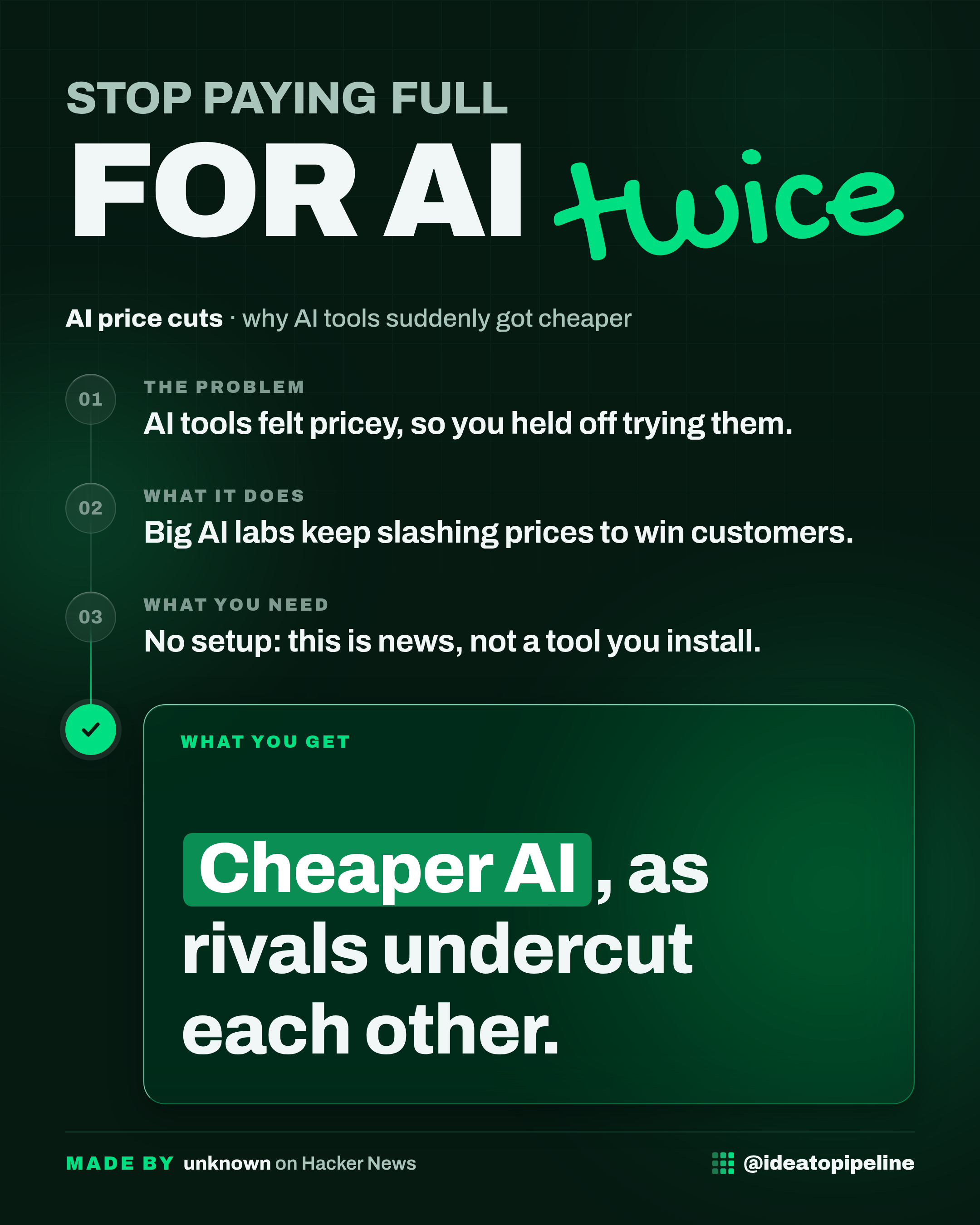
You looked at an AI tool, saw the monthly price, and closed the tab. Fair enough. But it turns out that price was never fixed. Over the past few months, the two biggest AI labs have been cutting what they charge.
This guide walks through what actually happened, in the order it happened, using a timeline published by Max Woolf on his blog. You will see which models got cheaper, by how much, why the cuts keep coming, and what it means if you are a small business owner or freelancer thinking about paying for AI.
What these AI price cuts are
The AI tools most people use are built on large language models, often shortened to LLMs. Think of an LLM as the engine inside the tool. You do not buy the engine directly. You pay for it through a subscription or an app. But the price of the engine quietly sets the price of everything built on top of it.
Recently, OpenAI and Anthropic have been undercutting each other. The source describes a clear tit-for-tat between the two companies, and it is reasonable to assume that these particular price cuts are in reaction to each other.
Max Woolf's post lays out a timeline of model announcements and price changes from June to late September 2026. He also explains why the cuts are happening and whether they are likely to stick.
What you can do with it
- Understand why the AI subscription you looked at last quarter may now cost less, or come with a cheaper option you did not see before.
- See which model families got cheaper and by how much, so you can judge whether a tool's price is reasonable.
- Learn what a cache read is and why it can quietly make an AI tool much cheaper to run, even when the headline price looks the same.
- Get a realistic view of whether these prices will rise again, so you can decide whether to wait or commit.
- Spot the difference between the price of a model and the price of a subscription, which do not always move together.
How to set it up
There is nothing to install here. This is a reading guide. The steps below are the timeline from the source, so you can follow how the prices moved.
- Start in June 2026. OpenAI announced GPT-5.6 Sol at the same price as the model before it, $5 input, $30 output and $0.50 cache read per million tokens. It also announced Luna, a smaller model built for cheaper use cases, at $1, $6 and $0.10.
- On June 30, Anthropic announced Claude Sonnet 5 with launch pricing of $2, $10 and $0.20. That price was meant to be temporary.
- On July 24, Anthropic announced Claude Opus 5 at $5, $25 and $0.50.
- On July 30, OpenAI cut the price of GPT-5.6 Luna by 80%, to $0.20, $1.20 and $0.02. The source suspects this cut was meant to compete with smaller open-weight models.
- On August 10, Anthropic made the temporary Sonnet 5 launch price permanent.
- On August 21, OpenAI cut GPT-5.6 Sol by about 20%, to $4, $20 and $0.40, for three months.
- On September 1, Anthropic announced Fable 5.1 at $10, $50 and $0.25. The input and output prices matched the older Fable 5, but the cache read cost dropped by 75%.
- On September 3, OpenAI announced GPT-6 Astra at $10, $50 and $1, without the lower cache read cost.
- On September 22, OpenAI announced GPT-6 Sol at $2, $10 and $0.20, half the input and output price of the discounted GPT-5.6 Sol. GPT-6 Luna arrived the same day at $0.10, $0.50 and $0.01. On the same day, Anthropic announced Claude Opus 5.5 at $4, $20 and $0.20, a total cost reduction of 40% to 60% over Opus 5, according to the source.
- On September 29, after GPT-6 Sol turned out to be a dud performancewise, OpenAI announced GPT-6.1 Sol at $2, $10 and $0.10, halving the cache price again and making the model family cumulatively 75% cheaper.
If those numbers look technical, do not worry. The short version is that each step made the same kind of work cheaper than the step before.
What it costs
The source lists prices per million tokens, split into input, output and cache read. You do not usually pay these prices directly. They flow into the tools and subscriptions you buy.
There is no price for the blog post itself. Check the official page before you rely on it.
One useful detail from the source: cache read costs can make up 96% to 99% of the total spend when you use AI agents for coding. That means a big cut to the cache read price can lower the real cost of using a model by 70% to 75%, even if the headline input and output prices barely move.
Who it's for
Good fit if you have been putting off trying a paid AI tool because the price felt high, or if you run a small business and want to understand why AI quotes keep changing.
Skip it if you need a fixed budget you can plan around for the next year. These prices keep moving.
Good to know
Prices are not the only thing that changed. The source notes that at the same time GPT-6.1 Sol was announced, OpenAI cut the usage allowance by 50% for the $200 per month tier in Codex. So a cheaper model does not always mean a cheaper subscription.
The source also pushes back on a common worry: that these low prices are a temporary trick and will rise sharply later. The author argues that as long as many inference providers can continue to serve models at a similar price and quality, and switching cost is negligible, prices may continue to decrease more. He may be wrong, but the argument is laid out in detail.
Finally, the source is a personal blog post, not an official announcement. Treat the timeline as a useful map, not a contract. Before you commit to any paid plan, check the current price on the official page. The price you saw last quarter may already be out of date.